

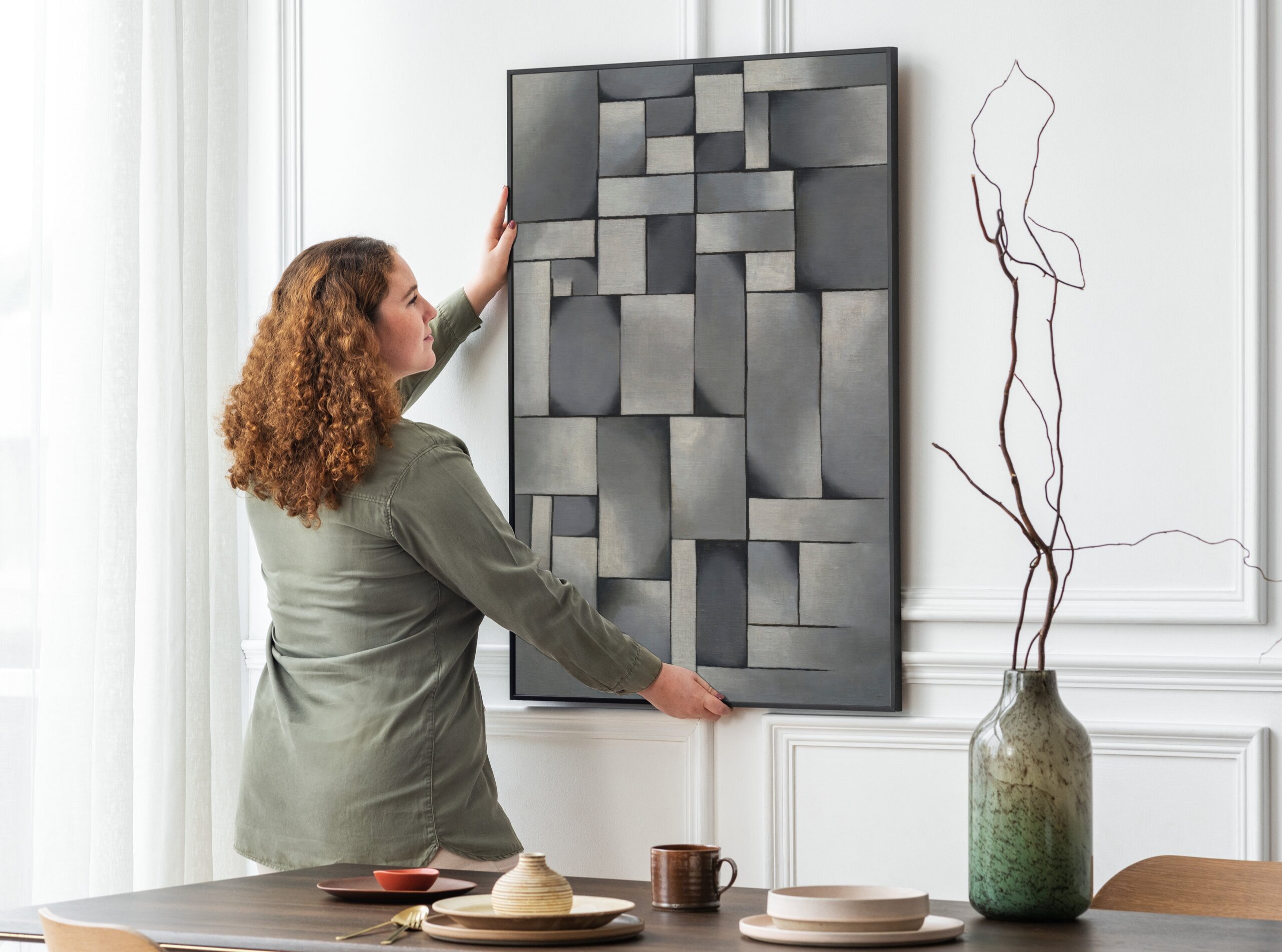


Abstract Composition in Gray, Theo van Doesburg
Theo van Doesburg (1883 – 1931) was a Dutch artist, who practiced painting, writing, poetry and architecture. He is best known as the founder and leader of De Stijl.
His first exhibition was in 1908. From 1912 onwards, he supported his works by writing for magazines. He considered himself to be a modern painter, at that time, although his early work is in line with the Amsterdam Impressionists and is influenced by Vincent van Gogh, both in style and subject matter.
This suddenly changed in 1913 after reading Wassily Kandinsky’s Rückblicke, in which he looks back at his life as a painter from 1903 to 1913. It made him realize there was a higher, more spiritual level in painting that originates from the mind rather than from everyday life, and that abstraction is the only logical outcome of this. It was already in 1912 that Van Doesburg was criticizing Futurism in an art article in Eenheid no. 127, on 9 November 1912, because “The mimetic expression of velocity (whatever its form may be: the aeroplane, the automobile, and so on) is diametrically opposed to the character of painting, the supreme origin of which is to be found in inner life”. On 6 November 1915, he wrote in the same journal: “Mondrian realizes the importance of line. The line has almost become a work of art in itself; one can not play with it when the representation of objects perceived was all-important. The white canvas is almost solemn. Each superfluous line, each wrongly placed line, any color placed without veneration or care, can spoil everything—that is, the spiritual”.
Available as a fine art print and as a stretched canvas panel (heavy fine art canvas stretched over 1.5 inch deep edge solid wood frame)
All prints are made using archival art stocks and UV pigment inks to give up to 200 years life. Prints are sold unframed and unmounted.


